
- AI
- AI Startups
- B200
- GPU
Why NVIDIA’s Blackwell B200 GPU Outshines the Hopper H100: A Quantum Leap in AI Acceleration
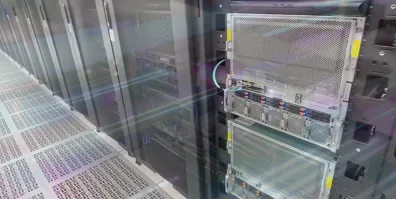
NVIDIA’s relentless innovation in GPU technology has reached a new pinnacle with the Blackwell B200, the flagship of its next-generation architecture. Designed to obliterate the limitations of its predecessor, the Hopper H100, the B200 isn’t just an incremental upgrade—it’s a paradigm shift for AI, data centers, and high-performance computing (HPC). Here’s why:
1. Revolutionary Architecture & Raw Performance
The B200 leverages NVIDIA’s Blackwell architecture, featuring a monolithic dual-die design connected by a 10 TB/s chip-to-chip link—a first in GPU engineering. This enables:
- 18 PetaFLOPS of FP4 compute power (vs. H100’s 4 PetaFLOPS of FP8), ideal for next-gen AI inference.
- 4.5× faster training performance for trillion-parameter LLMs.
- Support for FP4/FP6 precision, optimizing efficiency by reducing the model size and speeding up the processing while maintaining the high level of accuracy.
By contrast, the H100’s Hopper architecture, while groundbreaking in 2022, lacks the transistor density (80 billion vs. B200’s 208 billion) and multi-die scalability to handle tomorrow’s AI workloads.
2. Unprecedented Memory Dominance
Memory bottlenecks vanish with the B200:
- 192 GB of HBM3e RAM (vs. H100’s 80 GB HBM3), enabling single-GPU processing of models previously requiring complex multi-GPU setups.
- 8 TB/s memory bandwidth (2.4× faster than H100’s 3.35 TB/s), slashing latency for retrieval-augmented generation (RAG) and real-time inference.
This transforms workflows—fine-tuning a 70B-parameter model now takes hours, not days.
3. Power Efficiency Redefined
The B200 delivers 25× lower energy per inference than the H100. For hyperscalers like Google Cloud or AWS:
- A single B200 replaces 5× H100 nodes for Llama 3 inference, cutting costs and carbon footprints.
- Decomposition-Execution-Validation (DEV) technology dynamically allocates power, eliminating idle resource drain.
4. Next-Gen Interconnect & Scalability
Blackwell’s Fifth-Generation NVLink hits 1.8 TB/s bidirectional bandwidth (which is double of H100’s 900GB/s NVLink 4), enabling:
- Seamless scaling to 1.4 exaFLOP AI factories with 576 GPUs in a single cluster.
- Redundant GPUs to NVSwitch connections for fault-tolerant AI training — critical for trillion-parameter runs.
The H100’s 900 GB/s NVLink now looks like a bottleneck for frontier-scale AI.
5. Future-Proofed for Generative AI
The B200’s Transformer Engine 2.0 introduces:
- Micro-tensor scaling along with FP4/FP6 capabilities, doubling throughput and model sizes
- Secure AI capabilities via confidential computing—vital for healthcare and financial LLMs.
The Verdict
While the H100 remains a powerhouse, the B200 redefines the frontier. It’s not just about speed; it’s about scaling sustainably into the trillion-parameter era. As NVIDIA CEO Jensen Huang declared: “Blackwell isn’t a chip—it’s the engine of the new Industrial Revolution.” For enterprises betting on AI, skipping Blackwell isn’t an option.
Key Specs Comparison
| Feature | H100 (Hopper) | B200 (Blackwell) | Advantage |
|---|---|---|---|
| Compute (FP4) | 4 PFLOPS | 18 PFLOPS | 4.5× |
| Memory | 80 GB HBM3 | 192 GB HBM3e | 2.4× |
| Memory Bandwidth | 3.35 TB/s | 8 TB/s | 2.4× |
| NVLink Bandwidth | 900 GB/s | 1.8 TB/s | 2× |
| Power Efficiency | 1× baseline | 25× better | 25× |
Related resources

- AI
- B200
- GPU
Why Healthcare Needs Next-Gen AI Infrastructure
Why healthcare AI needs next-gen infrastructure — how the NVIDIA B200's memory, FP4 throughput and low latency power AI scribes, triage and diagnostics.
Read more
- AI
- Cloud
- Cloud GPU
Why Bare Metal Is Best For Your AI ROI: A Strategic Perspective
Why bare metal beats virtualized cloud for AI ROI: full GPU performance, predictable pricing up to 60–75% lower, data sovereignty and complete control.
Read more
- AI Startups
- B200
- Cloud GPU
Why AI Innovation Demands an Upgrade to NVIDIA B200 GPUs
Why AI developers are upgrading from H100 to NVIDIA B200 GPUs: up to 3x faster training, 15x inference and 192GB HBM3e for larger models at lower TCO.
Read more